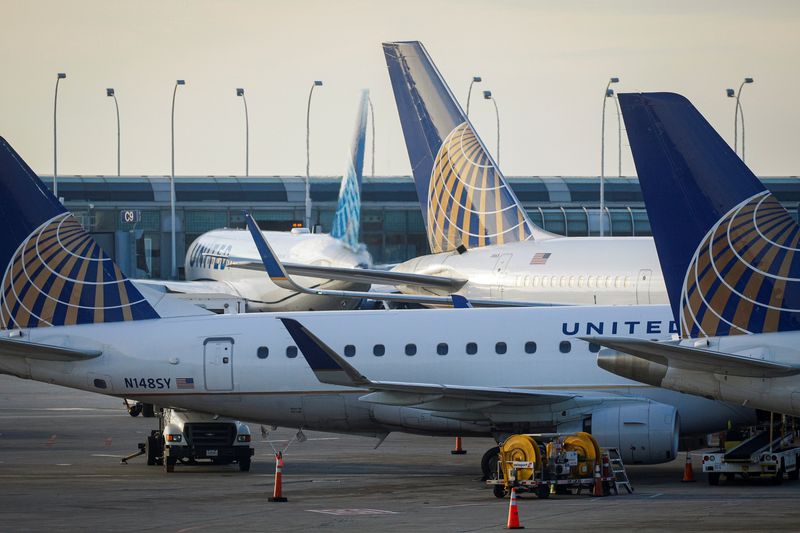
**United CEO Vows Massive Flight Surge to Defend O’Hare Gates Against American Airlines Expansion**
**CHICAGO, January 21** – United Airlines has dramatically intensified its ongoing rivalry with American Airlines at Chicago O’Hare International Airport (ORD), committing to an unprecedented defense of its turf. During a conference call following the company’s quarterly earnings release on Tuesday, United CEO Scott Kirby vowed a massive increase in flight capacity if necessary, specifically aiming to block American’s attempts to secure more gate space in 2026.
This operational skirmish, focusing on gate allocations and optimal schedule slots rather than pricing, is crucial for attracting lucrative corporate travelers who generally book higher-cost tickets. O’Hare remains one of the few large U.S. airports where two legacy network carriers operate hubs of similar scale.
For American Airlines (AA), which identifies ORD as its third-largest hub, the current objective is to restore its presence after its post-pandemic schedule lagged 2019 volumes. Conversely, Chicago-based United is intent on solidifying and expanding its long-held dominance.
**A Line Drawn in the Sand**
Kirby made it clear that United views 2026 as a critical turning point. "We are drawing a line in the sand," he stated. "We will commit whatever capacity is needed to ensure our current gate count in Chicago is maintained, preventing AA from making any inroads at our expense."
The CEO also provided stark financial comparisons, asserting that United generated approximately $500 million in profit in the Chicago market in 2025, while American recorded a commensurate loss. He forecasted that if AA continued its current strategy, its financial shortfall in the region could potentially double to $1 billion in 2026.
Substantiating his claims of market superiority, Kirby maintained that United now holds a substantial competitive edge among local travelers: a 22-point advantage with Chicago-based customers and a commanding 38-point lead among high-value business passengers—a reversal of what he described as American's advantage nearly a decade prior in 2016.
American Airlines did not immediately issue a response regarding the specific figures cited by Kirby. While United’s CEO frequently characterizes American’s ORD operations as fiscally unsound, AA CEO Robert Isom has consistently defended the market, arguing O’Hare is robust enough to sustain two leading hub carriers.
**The Battle Over Infrastructure**
Operational capacity at ORD hinges directly on gate availability, dictating the volume and reliability of flight schedules. Data from Cirium confirms United's prevailing footprint, scheduling nearly half of the airport’s departures compared to American’s roughly one-third share.
This disparity increased significantly in late 2025 following a city-led reallocation of gates, which granted United five extra positions while reducing American’s total by four—a move AA unsuccessfully contested in court.
American insists this setback is temporary as it continues to expand its scheduling. To mitigate the loss, AA has acquired two gates from Spirit Airlines for $30 million and anticipates receiving three further gates later this year through an allocation review process.
Despite the intense competition for gate access, both carriers are substantially boosting flight volumes at O’Hare. United intends to run nearly 650 daily departures this summer, serving approximately 200 destinations. American countered by announcing its largest-ever spring schedule for the airport, adding about 100 peak-day flights to reach a total exceeding 500 daily departures.
The continuing escalation highlights O’Hare’s unusual status in the U.S. aviation landscape, remaining one of the few large metropolitan hubs where two massive network carriers contest market share aggressively, unlike markets such as Atlanta (Delta), Houston (United), or Dallas (American), which are typically controlled by a single dominant airline.