## CES 2026: Morgan Stanley Highlights ‘Skyrocketing’ AI Demand Driven by Nvidia’s Rubin Platform
The CES 2026 conference solidified Artificial Intelligence’s role as the central market driver, with technology giant Nvidia commanding considerable attention. According to a detailed analysis from Morgan Stanley, the firm delivered a "decidedly positive" keynote that signaled surging momentum across its core businesses, including AI hardware, robotics, and its burgeoning automotive division.
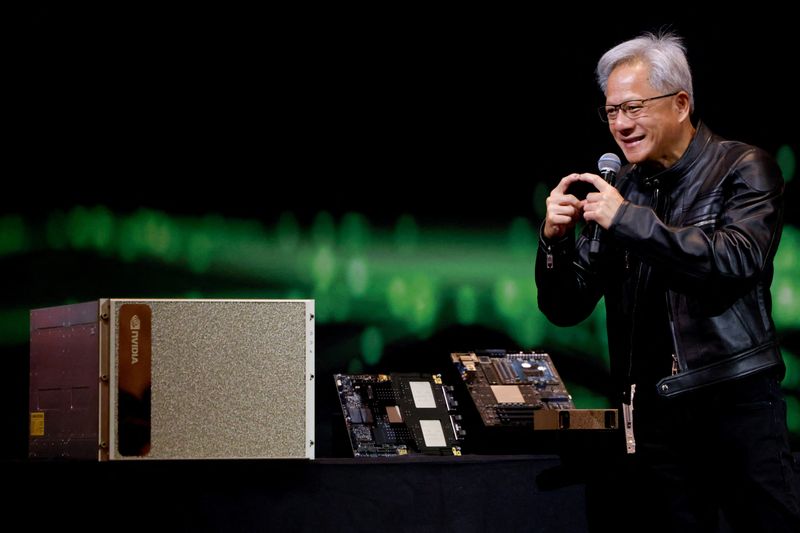
Analyst Joseph Moore noted that CEO Jensen Huang dedicated a surprisingly large portion of his address—typically geared toward consumer electronics—to the unveiling of the new Rubin platform. Morgan Stanley expects Rubin to "once again elevate the benchmark for performance," underscoring Nvidia’s focus on integrated, system-level innovations encompassing the GPU, CPU, networking infrastructure, and proprietary software.
Further technical insights included the spotlighting of new BlueField DPUs and CPX offerings, alongside a description of a new inference memory platform touted to boost Transaction Per Second (TPS) throughput by up to five times compared to standard storage solutions.
### Focus on Production Efficiency and Market Scale
Equally critical was the emphasis on manufacturability. Morgan Stanley highlighted Nvidia’s claims that Rubin is already in "full production," with assembly time drastically cut to approximately five minutes—a significant efficiency gain compared to the two hours typically required for the previous Blackwell generation. The investment bank anticipates that the first production racks are currently being deployed, projecting substantial revenue generation during the latter half of 2026.
Demand for both general AI infrastructure and the Rubin platform specifically was characterized by Nvidia as "skyrocketing." Moore observed that management conveyed "no hedging" regarding future supply capabilities or market demand, even while acknowledging that memory components remain a primary limiting factor. Furthermore, the company confirmed persistent interest from the Chinese market, although regulatory approval for the H200 series licensing is still pending.
Shifting focus away from the core data center business, Morgan Stanley also pointed to Nvidia's notable progress in the automotive sector, citing the introduction of a new "reasoning-enabled" autonomous driving model and updates concerning the upcoming rollout of its collaboration with Mercedes-Benz.
### AMD: Ecosystem Growth vs. TCO Challenge
In contrast, the analysis of AMD’s presence yielded fewer immediate headline shifts. While there were no novel announcements regarding the MI450 chip, Morgan Stanley noted positive "testimonials" indicating a robust and expanding ecosystem surrounding AMD’s current offerings.
Analyst Moore concluded that little transpired at CES to significantly reshape the ongoing discourse surrounding AMD stock. Management remains highly confident in the MI455 as a leading product, and with major clients like OpenAI serving as an "anchor customer," the firm anticipates a vigorous production ramp-up in the third and fourth quarters of this year.
However, the bank cautioned that AMD’s current success is partially attributable to the "overwhelming overall demand for compute." For AMD to achieve sustainable, long-term success, they must pivot from relying on sheer market buoyancy to establishing a clear Total Cost of Ownership (TCO) advantage over competitors, especially as Nvidia consistently advances its entire technology stack.