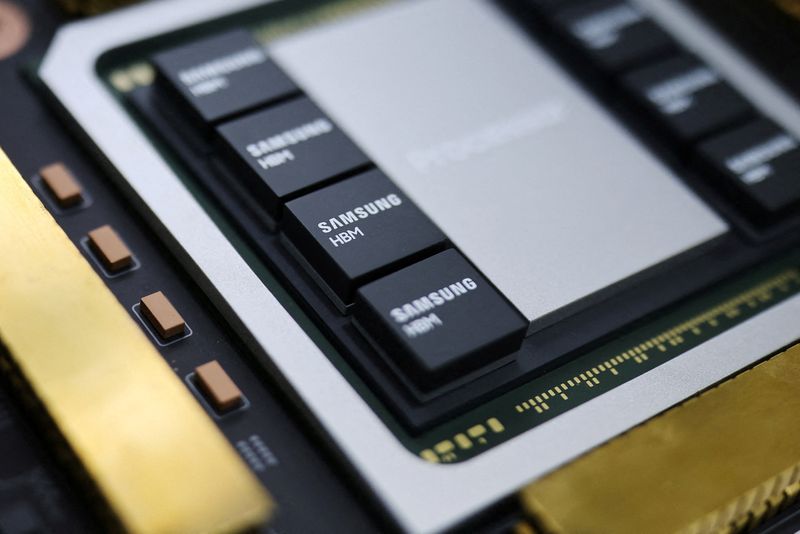
## Semiconductor Demand Propels Samsung’s Financial Revival Amidst Global AI Boom
**SEOUL –** Samsung Electronics is poised to report an exponential surge in its fourth-quarter operational earnings, driven by relentless demand stemming from the artificial intelligence sector and a resulting squeeze on global semiconductor supply. The intensifying chip shortage has aggressively propelled memory prices upward, positioning the South Korean technology giant for its strongest financial performance in years.
The world’s leading memory chip manufacturer is anticipated to unveil an operating profit of 16.9 trillion won ($11.7 billion) for the October-to-December period, according to an LSEG SmartEstimate drawing on forecasts from 31 analysts. This figure marks a staggering 160% increase compared to the 6.49 trillion won recorded a year prior, nearing the company’s all-time quarterly high of 17.6 trillion won set back in the third quarter of 2018. The robust price environment has led some market watchers to revise forecasts even higher in recent weeks, projecting final figures exceeding 20 trillion won. Samsung is scheduled to release its initial revenue and operating profit estimates later this week.
### The Dynamics of Soaring Chip Costs
The primary factor driving this financial uplift is the dramatic appreciation of memory chip costs. Industry dynamics are shifting heavily toward specialized AI processors, unintentionally constraining production capacity for traditional memory types. Yet, demand is simultaneously soaring for both conventional and advanced chips—all necessary for the massive undertaking of training and deploying sophisticated AI models.
Market analysis from TrendForce highlighted this momentum, reporting that prices for DDR5 DRAM, a high-efficiency conventional chip used widely in servers and devices, skyrocketed 314% year-over-year in the fourth quarter. Looking ahead, TrendForce anticipates further significant gains, predicting that conventional DRAM contract prices will climb another 55% to 60% in the current quarter compared to the prior three months. Analyst Avril Wu from TrendForce noted that since Samsung’s production capability is substantially concentrated in the conventional segment, the company stands to gain disproportionately from the ongoing price upcycle.
This market tightness is expected to persist well beyond the near term. Micron Technology, for instance, recently forecast adjusted profits for its second quarter that nearly doubled Wall Street’s estimates. Micron CEO Sanjay Mehrotra has publicly stated his expectation that memory markets will remain supply-constrained past 2026, anticipating that the industry will only meet between half and two-thirds of key customer demand in the medium term.
### HBM Strategy and a Pivotal Comeback
The projected success signifies a pivotal comeback for Samsung. Just over a year ago, CEO Jun Young-hyun had to apologize for disappointing earnings results, largely due to the company trailing competitor SK Hynix in delivering crucial high-end high-bandwidth memory (HBM) chips to Nvidia, the dominant manufacturer of AI hardware.
Reflecting investor confidence in the recovery, Samsung’s shares surged 125% last year, marking its best annual percentage gain in 26 years. CEO Jun recently provided further impetus to the rally by relaying highly positive customer feedback regarding the competitive superiority of Samsung's upcoming HBM4 memory chips, citing customer claims that "Samsung is back." While the specific clients were not named, analysts suggest Samsung is making significant strides in gaining share against rivals like SK Hynix and Micron, especially with regard to supplying Nvidia.
Further cementing the outlook, Nvidia CEO Jensen Huang confirmed that the company's next generation of processors is already in full production. Nvidia stated that the Vera Rubin platform, which is slated to incorporate HBM4 chips, remains on schedule for arrival later this year.
### Future Projections and Emerging Headwinds
Looking ahead, market watchers forecast that Samsung’s overall operating profit could more than double this year, potentially exceeding 100 trillion won. The expectation is that sustained momentum in chip pricing will easily counteract any anticipated sluggishness in its mobile communications division.
However, this financial ascent is not without friction. While the global chip shortage benefits Samsung’s core semiconductor business, the soaring component costs are simultaneously squeezing margins in the smartphone division, which is the company's second-largest revenue source.
Analyst Lee Min-hee of BNK Investment & Securities voiced caution regarding current valuations, pointing out that sharply rising component prices could eventually dampen demand for end-user devices like PCs and smartphones. Lee also raised concerns over the "risks of a demand slowdown" fueled by AI data centers that are increasingly leveraging significant debt to finance necessary infrastructure investments. Acknowledging the complex challenge, Samsung co-CEO TM Roh, who oversees the mobile and home appliance divisions, confirmed to Reuters that the current situation is "unprecedented," adding that while the company is attempting to minimize the impact, some friction looks "inevitable."