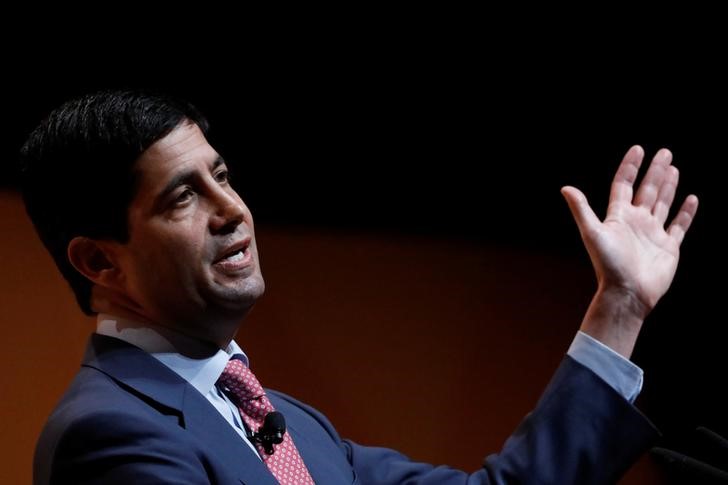
President Donald Trump has fundamentally reshaped the trajectory of American monetary policy by nominating Kevin Warsh to succeed Jerome Powell as Chairman of the Federal Reserve. The announcement, which positions Warsh to take the helm of the world’s most influential central bank when Powell’s term concludes in May 2026, marks a pivotal moment for global capital markets. Describing Warsh as a figure drawn from "central casting," the President’s endorsement underscores a desire for a leadership style that blends traditional financial pedigree with a more assertive ideological alignment. This transition arrives at a critical juncture for the domestic economy, as investors weigh the implications of a changing guard against a backdrop of evolving inflationary pressures and significant sector rotations, including recent volatility in the software and technology spaces.
Warsh is no stranger to the inner workings of the Eccles Building, having served as a Federal Reserve Governor from 2006 to 2011. Appointed at the age of 35—the youngest in the institution’s history—he was a central figure during the 2008 financial crisis, acting as a crucial bridge between the central bank and the volatile corridors of Wall Street. His subsequent career has only deepened his ties to the upper echelons of high finance and economic thought, encompassing roles at the Hoover Institution and a partnership with legendary macro investor Stanley Druckenmiller at Duquesne Family Office. This unique synthesis of public service and private-sector acumen provides him with a vantage point that many analysts view as a strategic asset for navigating the complexities of modern liquidity management and regulatory oversight.
Initial market reactions reflect a nuanced interpretation of Warsh’s potential chairmanship. While some segments of the equity market experienced a retreat and precious metals saw a significant unwinding of recent trades, bank policy analysts have expressed measured optimism. The prevailing sentiment among industry experts suggests that Warsh’s deep-seated understanding of the regulatory landscape could foster a more streamlined environment for the banking sector. Furthermore, his historically hawkish leanings are being interpreted by some as a constructive force for stabilizing long-term interest rates, a development that could provide much-needed relief to the housing market. However, as the broader market processes this shift, the primary challenge for Warsh will be maintaining the bedrock of investor confidence that underpins the global financial system.
Despite his deep institutional credentials, Warsh remains an iconoclastic figure whose appointment suggests a departure from the status quo. His 2011 resignation from the Fed board, spurred by disagreements over the direction of unconventional monetary policy, highlights a long-standing skepticism of the central bank’s expansive maneuvers. Strategists note that Warsh has frequently called for a re-evaluation of the 1951 Fed-Treasury Accord, advocating for closer coordination between the Fed’s balance sheet management and the Treasury’s debt issuance. This perspective, coupled with his vocal critiques of Chair Powell’s leadership—which he has characterized as "broken" due to its focus on social and environmental mandates—suggests a tenure that will prioritize a return to a narrower, congressionally mandated remit.
Ultimately, the Warsh nomination represents a calculated bet by the administration on a leader who promises both professional rigor and a willingness to challenge established orthodoxies. While he may be viewed as a more "central" choice compared to other rumored candidates, his commitment to revisiting the boundaries of Fed autonomy suggests that his leadership will be anything but conventional. As the Senate confirmation process looms, the financial community remains focused on whether Warsh can successfully balance his iconoclastic instincts with the institutional stability required to anchor the world’s largest economy. His success will likely be measured by his ability to restore a sense of accountability to an institution that he believes has strayed too far from its primary economic mission.