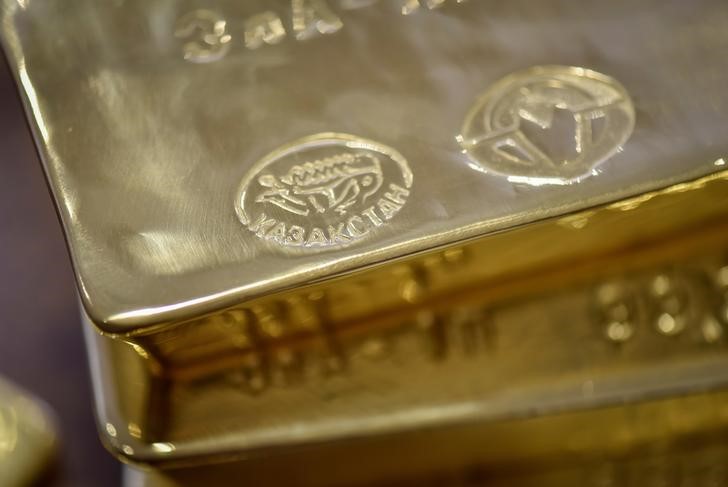
The global financial landscape is currently navigating a period of profound instability, as a volatile cocktail of protectionist trade rhetoric and escalating geopolitical friction reshapes investor priorities. While Asian equity markets managed to find some footing on Tuesday, buoyed by a resilient lead from Wall Street and a tentative rebound in South Korean shares following recent tariff-induced jitters, the underlying sentiment remains decidedly cautious. This fragility is most visible in the precious metals complex, where gold continues its historic ascent, driven by a fundamental shift in the global risk assessment.
Spot gold advanced 1.1% to $5,062.97 per ounce during Asian trading hours, maintaining its trajectory near the record high of $5,111.11 established only a day prior. Although April gold futures saw a marginal retreat of 0.5% to $5,098.26, the broader bullish thesis remains unchallenged. Market veterans, including Ed Yardeni, have begun to entertain long-term projections that could see the yellow metal reach the $10,000 threshold, a figure that reflects the deepening erosion of confidence in traditional sovereign assets. This momentum is further mirrored in the auxiliary metals; silver surged nearly 4% to $107.9350 after breaching the $111 mark, while platinum climbed 2.7% to $2,656.27.
The catalyst for this flight to safety is largely rooted in the assertive trade posture of the U.S. administration. President Donald Trump’s threat of a 100% tariff on Canadian goods—effectively a trade embargo—stemming from concerns over Ottawa’s economic ties with China, has sent shockwaves through the North American supply chain. This was compounded by the President’s announcement of a 25% tariff on South Korean exports, a move attributed to perceived delays in the implementation of existing trade agreements. While the White House has offered some moderation regarding European trade and territorial discussions involving Greenland, the overarching threat of arbitrary protectionism keeps global markets in a state of perpetual high alert.
Simultaneously, heightened geopolitical tensions in the Middle East are providing additional tailwinds for safe-haven assets. The arrival of U.S. naval assets in the region amid escalating friction with Iran has introduced a layer of military risk that investors cannot ignore. Against this backdrop, the Federal Reserve’s upcoming policy meeting looms large. Although the central bank is widely expected to maintain current interest rates on Wednesday, the mere anticipation of the Fed’s forward guidance has encouraged a risk-averse stance, as investors weigh the dual pressures of persistent inflation and geopolitical instability.
Institutional analysts are increasingly viewing this environment as a structural shift rather than a transient spike in volatility. Analysts at ANZ have observed that the investment case for gold has broadened significantly, transcending regional boundaries as nations like China and India actively encourage gold ownership. Corroborating this view, OCBC Bank recently revised its 2026 gold price target upward to $5,600 per ounce, citing a "sustained backdrop of uncertainty" that favors diversification into non-sovereign assets. While some near-term consolidation and profit-taking are anticipated following such a rapid rally, the prevailing consensus suggests that the drivers of the current bull market are deeply entrenched in the modern economic order.