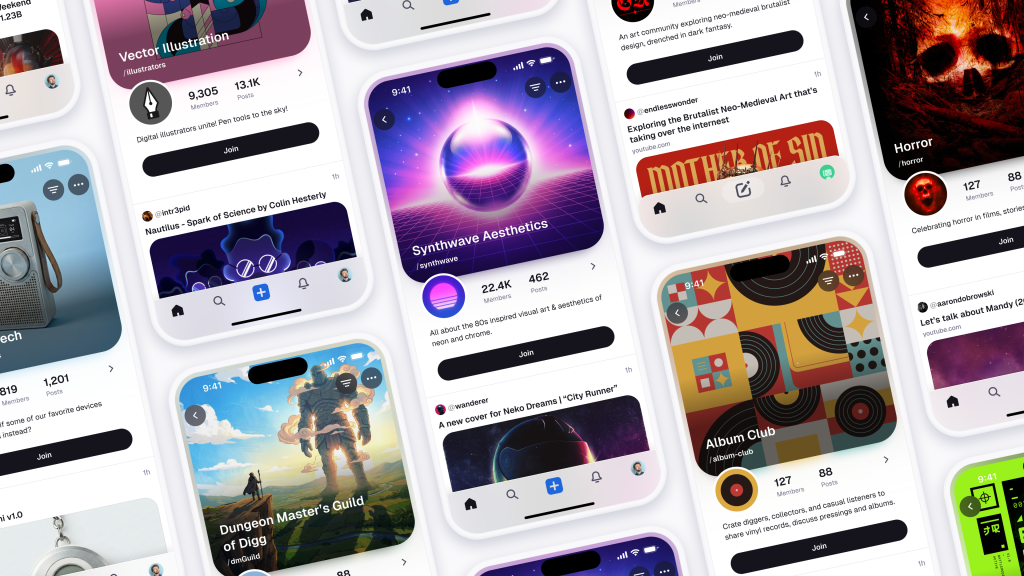
Similar to Reddit, the new Digg offers a website and mobile app where you can browse feeds featuring posts from across a selection of its communities and join other communities that align with your interests. There, you can post, comment, and upvote (or “digg”) the site’s content.
They’re betting that AI can help to address some of the messiness and toxicity of today’s social media landscape. At the same time, social platforms will need a new set of tools to ensure they’re not taken over by AI bots posing as people.
“We obviously don’t want to force everyone down some kind of crazy KYC process,” said Rose in an interview with TechCrunch, referring to the “know your customer” verification process used by financial institutions to confirm someone’s identity.
Instead, he proposes that Digg should pick up “little signals of trust along the way and bundle them all together into something that’s meaningful.”
As an example, a community for Oura ring owners could verify that everyone who posts has proven they own one of the smart rings.
Plus, Rose suggests Digg could use signals acquired from mobile devices to help verify members — for instance, the app could identify when Digg users attended a meetup in the same location.
“I don’t think there’s going to be any one silver bullet here,” said Rose. “It’s just going to be us saying … here’s a platter of things that you can add together to create trust.”
Before today’s public beta launch, the site offered 21 more generalized communities like gaming, technology, and entertainment, and was open to 67,000 users on an invite-only basis. Now anyone will be able to join and start their own communities on nearly any topic, no matter how niche — a top request from beta testers. The community managers (i.e., moderators) for these individual forums will be able to set their own rules, and their moderation logs will be shared publicly, so members can see what decisions are being made.
The site has also been redesigned since its private beta, now offering a new sidebar where you can pin your favorite communities and a main feed optimized for visual elements.
“We kind of opted for … let’s just keep building this plane as we fly it,” explained Digg CEO Justin Mezzell. “That means that it’s going to be very lightweight, and we’re just going to be aggressively shipping every week and just giving them new features as we go,” he added.
The company also plans to listen to its community managers about what they need and build accordingly, and it has brought on some Reddit moderators as advisers. Although Reddit was built on the back of volunteer moderators, Digg aims to find a model that improves the moderator experience. Plans on this front haven’t been fleshed out yet, however, but Mezzell said it “has to be a conversation.”
“We need to figure out a way to make this an equitable experience for everybody who’s actually building Digg into what it needs to become,” he noted.
In addition, the team is considering shifting its AI-created podcast about the interesting stories surfacing on Digg into a human-hosted version, as users have been requesting.
Rose told TechCrunch that the current team is small, giving them “years of runway” to find product-market fit.
“The beautiful thing about this launch is we’re finally at the place with Digg where it’s just that the foundational stuff is done, and now we can really start having fun,” he said.
Note: The rollout should begin around 4 PM ET.
International