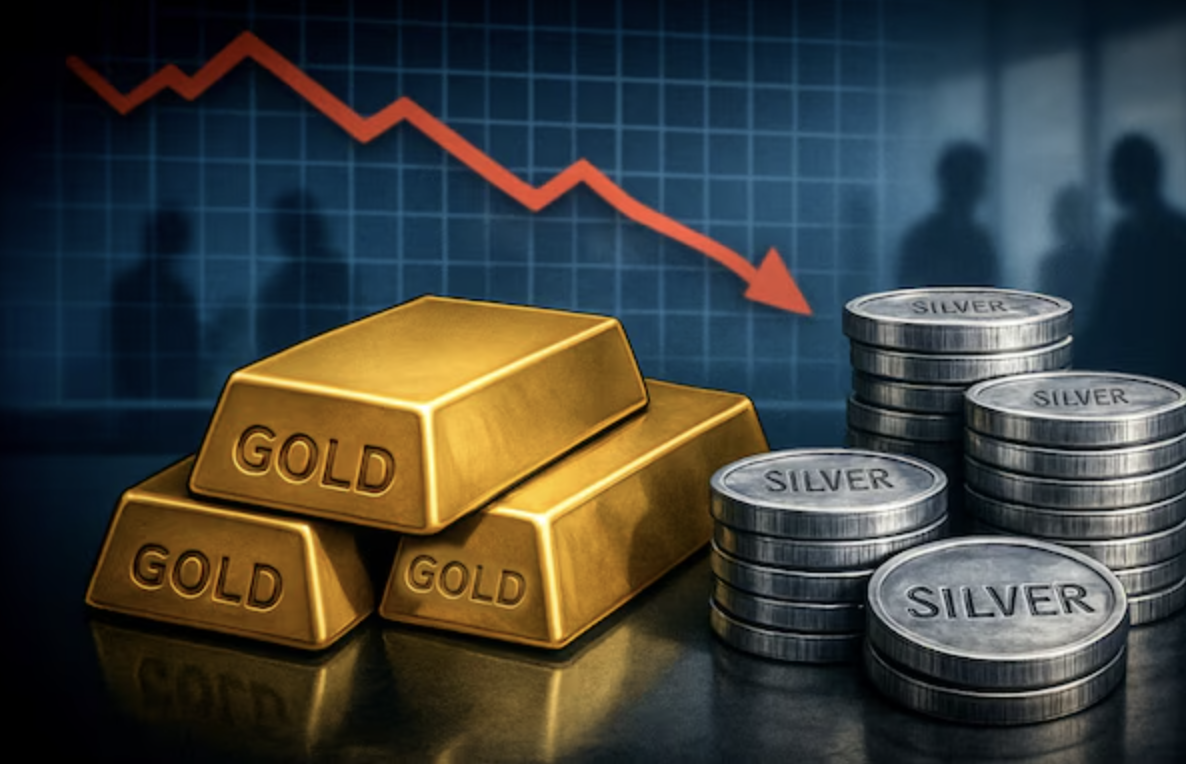
The precious metals market underwent a seismic shift on Friday as gold and silver experienced a precipitous retreat that eclipsed even the most volatile periods of the 2008 financial crisis. Gold bullion suffered an intraday collapse of more than 12% before settling near the $4,870 mark, representing a daily loss of approximately 9%. The carnage was even more pronounced in the silver market, where the metal plummeted by nearly 27% to trade below $85 per ounce, having at one point endured a staggering intraday drawdown exceeding 35%. This dramatic reversal serves as a stark reminder of the fragility of speculative rallies when confronted with shifting institutional narratives.
For several weeks, the primary tailwind for precious metals had been a growing anxiety regarding the future of the Federal Reserve’s independence. Markets had increasingly priced in a "politicization premium" amid repeated critiques from Donald Trump toward Jerome Powell, fueling fears that the central bank’s autonomy might be compromised by a purely political appointment. However, the nomination of Kevin Warsh has fundamentally altered this calculus. As a former Fed Governor with an extensive background at Morgan Stanley, Warsh possesses the institutional gravitas and technical expertise that global markets associate with traditional monetary stewardship. His selection has largely neutralized the perceived threat of an executive-led overhaul of the central bank, prompting a rapid and violent unwinding of hedges against a breakdown in monetary credibility.
This realignment of institutional risk triggered an immediate resurgence in the U.S. dollar, which gained roughly 1% against a basket of major currencies including the euro and pound sterling. Because precious metals are denominated in greenbacks, this currency strength exerted significant mechanical pressure on prices, particularly as the previous rally was driven more by speculative financial flows than by physical supply constraints. Interestingly, the Treasury market remained relatively insulated from the chaos; the 10-year yield held steady near 4.24%, suggesting that the sell-off was not a reflection of a broader macroeconomic shock, but rather a surgical correction of an overextended thematic trade.
The sheer velocity of the decline was exacerbated by what many analysts describe as extreme investor positioning. Only a day prior, gold had reached a historic zenith above $5,590, while silver had eclipsed $121 following a staggering 70% year-to-date ascent. Such parabolic moves often leave markets vulnerable to "long-squeeze" events, where a single catalyst—in this case, the White House announcement—triggers a cascade of stop-loss orders. In the silver market, the correction was further compounded by deteriorating industrial fundamentals. The recent price surge had begun to cannibalize demand in the solar sector, forcing manufacturers to explore alternative materials to protect their margins, thereby weakening the metal's industrial floor.
While the structural drivers of the gold market—including persistent geopolitical instability and ballooning global debt—remain largely intact, Friday’s price action indicates that the specific premium associated with Federal Reserve uncertainty has been decisively extracted. The market has effectively transitioned from a state of speculative excess to one of forced normalization, acknowledging that the immediate threat to the central bank’s integrity has, at least for the foreseeable future, been significantly mitigated.
Stock Market
Samedi 31 Janvier 2026